Public Lab Desktop Spectrometry Kit
The Public Lab Desktop Spectrometry Kit guides students through building, calibrating, and using an open-source visible-light optical spectrometer. Students construct a benchtop optical enclosure complete with an entrance slit, transmission diffraction grating, and a focus-adjustable digital imaging sensor connected over USB. Using Spectral Workbench software, learners calibrate wavelength scales, assess sensor linearity, and acquire both emission and absorption spectra. Key experimental applications include flame spectroscopy, Beer-Lambert law concentration analysis, atmospheric spectral observations, and chemical identification tests ranging from olive oil adulteration and laundry brightening agents to tomato lycopene and wine sugar content. Through these hands-on investigations, students gain practical insight into optical system design, quantitative spectrophotometry, and analytical chemistry techniques.
Uploaded by demo on 2026-09-03 · ready · Electronics · Original source ↗
Files: Gemfile · Gemfile.lock · spectral-workbench_README.md · spectrometer3_kit_plans.zip
Readiness checks
-
complete 2026-09-03 03:04 🛡 Cybersecurity: Do not place on an open network · 15 findings 7 searches · 11 pagesview · PDF
Latest report — 2026-09-03 03:04
Readiness: Public Lab Desktop Spectrometry Kit
Verdict: Ready with caveats · 2026-09-03 · est. parts cost $31–$86 (four purchased lines; cardstock and laser cutting not priced) Cybersecurity — software & network: Do not place on an open network
This is the cold check for this lab — there is no previous report, so this one establishes the baseline every future check will measure drift against. Every purchasable item in the bill of materials is in stock today from multiple sellers, and both laser-cut enclosure files are still served from the project's GitHub repository. Two things keep this off a clean "Ready". First, publiclab.org served nothing to the checker: the 0.2 mm slit-card cut template and the whole body of assembly and calibration notes the lab leans on could not be verified this run, and whether that is a bot block or an outage was not established — verify by hand. Second, no single product listing verifies both manual focus and enclosure fit for the webcam, so the specific model you order needs a look before you buy a class set. Neither is a sourcing failure: every part here is cheap, commodity, and available from several sellers at once.
Action required
| Part | Problem | Recommended action |
|---|---|---|
| Precision Slit Card (0.2 mm) | The Public Lab note holding the cut template (publiclab.org/n/11246) could not be downloaded by the checker — "blocked, timeout, or gone" | Open the note in a browser to confirm it is reachable and save the template locally. Nothing needs purchasing: the snapshot allows any rigid opaque substrate with a 0.2 mm slit |
| Focus-Adjustable USB Webcam Module | No listing verifies manual focus and fit in the 35 mm enclosure compartment together | Before a bulk order, buy one unit and confirm the lens focuses manually at a 200 mm object distance and the housing fits (or comes off) |
Cybersecurity — software & network
Do not place on an open network — The runtime is past end of life and the pinned Rails 5.2.4.6 carries critical remote-code-execution advisories on the web application students connect to, with the fix blocked by the project's own rails ~> 5.2.4.3 constraint.
| Component | Version | How known | Support status |
|---|---|---|---|
| Host operating system (Ubuntu / Debian Linux) | 18.04 | inferred (Snapshot records Ubuntu 18.04 LTS as the documented target; the fetched README (fetched/03-README.md line 35) says only 'for an Ubuntu/Debian system' with no version.) | extended/LTS support only until 2028-04-26 |
| Ruby language runtime | 2.6.6 | read from project (fetched/03-README.md line 31 ('The app now runs on Ruby 2.6.6 up to Ruby 2.6.x') and line 58 ('rvm install 2.6.6').) | unsupported since 2022-03-31 |
| Ruby on Rails | 5.2.4.6 | read from project (fetched/01-Gemfile.lock; the Gemfile declares 'gem "rails", "~> 5.2.4.3"' (fetched/02-Gemfile line 5).) | — |
| Bundler | 1.17.2 | read from project (fetched/01-Gemfile.lock lines 280-281, 'BUNDLED WITH 1.17.2'.) | — |
| Puma (application server) | 5.6.4 | read from project (fetched/01-Gemfile.lock line 127; the Gemfile declares 'gem "puma"' with no version constraint (fetched/02-Gemfile line 17).) | — |
| Phusion Passenger (application server) | 6.0.14 | read from project (fetched/01-Gemfile.lock; the Gemfile declares 'gem "passenger"' with no version constraint (fetched/02-Gemfile line 38).) | — |
| Rack (web server interface) | 2.2.4 | read from project (fetched/01-Gemfile.lock line 130; required as 'rack (~> 2.0, >= 2.0.8)' at line 17.) | — |
| Nokogiri (XML/HTML parser) | 1.13.8 | read from project (fetched/01-Gemfile.lock line 107; required as 'nokogiri (~> 1.8)' at lines 56 and 239.) | — |
| rails-html-sanitizer (HTML sanitisation) | 1.4.3 | read from project (fetched/01-Gemfile.lock line 160; required as 'rails-html-sanitizer (~> 1.0, >= 1.0.2)' at line 20.) | — |
| loofah (HTML sanitisation) | 2.18.0 | read from project (fetched/01-Gemfile.lock line 86; required as 'loofah (~> 2.3)' at line 161.) | — |
| REXML (XML parser) | 3.2.5 | read from project (fetched/01-Gemfile.lock line 182; required as 'rexml (>= 3.2.5, < 4.0)' at line 190.) | — |
| RMagick (image processing binding) | 4.2.6 | read from project (fetched/01-Gemfile.lock; the Gemfile declares 'gem "rmagick"' with no version constraint (fetched/02-Gemfile line 42).) | — |
| rdiscount (Markdown renderer) | 2.2.0.2 | read from project (fetched/01-Gemfile.lock; the Gemfile pins it exactly as 'gem "rdiscount", "2.2.0.2"' (fetched/02-Gemfile line 47).) | — |
| mysql2 (database driver) | 0.5.4 | read from project (fetched/01-Gemfile.lock; the Gemfile declares 'gem "mysql2", "~> 0.5.4"' (fetched/02-Gemfile line 9).) | — |
| paperclip (file attachments) | 6.1.0 | read from project (fetched/01-Gemfile.lock.) | — |
| recaptcha | 5.9.0 | read from project (fetched/01-Gemfile.lock; the Gemfile pins 'gem "recaptcha", "5.9.0"' (fetched/02-Gemfile line 39).) | — |
| open_id_authentication (student login via publiclab.org) | 1.3.0 | read from project (fetched/01-Gemfile.lock; declared as 'gem "open_id_authentication"' at fetched/02-Gemfile line 53.) | — |
| ruby-openid (student login via publiclab.org) | 2.9.2 | read from project (fetched/01-Gemfile.lock line 199; declared as 'gem "ruby-openid"' at fetched/02-Gemfile line 55.) | — |
| therubyracer (JavaScript runtime) | 0.12.3 | read from project (fetched/01-Gemfile.lock.) | — |
| uglifier (asset minifier) | 4.2.0 | read from project (fetched/01-Gemfile.lock.) | — |
| bootsnap | 1.12.0 | read from project (fetched/01-Gemfile.lock.) | — |
| sprockets (asset pipeline) | 4.1.1 | read from project (fetched/01-Gemfile.lock.) | — |
| ImageMagick and development headers (imagemagick, ruby-rmagick, libmagickwand-dev, libmagick++-dev) | not determined | unpinned (Installed by apt with no version: fetched/03-README.md line 43.) | — |
| Node.js, npm and Yarn (static assets) | not determined | unpinned (Installed with no version: fetched/03-README.md lines 64-72 ('apt-get install nodejs-legacy', 'npm install -g yarn').) | — |
| Database engine (MySQL Server or SQLite3) | not determined | unpinned (Installed by apt with no version: fetched/03-README.md line 39 ('sudo apt-get install mysql-server').) | — |
| spectral-workbench.js (core spectral JavaScript library) | not determined | not determined (Included from https://github.com/publiclab/spectral-workbench.js with no pinned revision; no manifest for it was fetched this run.) | — |
| Component | Finding | Severity | Fix available? |
|---|---|---|---|
| Bundler 1.17.2 | The Bundler version recorded in the lockfile can be tricked into installing code from an attacker-controlled gem source when dependencies are installed. — GHSA-jvgm-pfqv-887x, GHSA-fp4w-jxhp-m23p, GHSA-g98m-96g9-wfjq, GHSA-fj7f-vq84-fh43 | critical | Yes — update to 2.2.33 or later; Bundler is installed by the person setting the machine up, not pinned by the project. |
| Nokogiri 1.13.8 | Nokogiri, which parses the XML and HTML the application handles, is 20 advisories behind including critical flaws in the libxml2 library it bundles. — GHSA-353f-x4gh-cqq8, GHSA-qv4q-mr5r-qprj, GHSA-mrxw-mxhj-p664 | critical | Yes — update to 1.18.9, allowed by the lockfile's 'nokogiri (~> 1.8)' requirement; confirm it installs on Ruby 2.6.6 before relying on it. |
| Puma 5.6.4 | The web server students connect to has a critical HTTP request-smuggling flaw, which matters only if the server is ever reachable from beyond the host machine. — GHSA-68xg-gqqm-vgj8, GHSA-c2f4-cvqm-65w2, GHSA-9hf4-67fc-4vf4 | critical | Yes — update to 5.6.9; the Gemfile declares 'gem "puma"' with no version constraint, so nothing blocks it. |
| Ruby on Rails (activerecord, activestorage) 5.2.4.6 | The pinned Rails 5.2.4.6 carries critical remote-code-execution and arbitrary-file-read advisories in Active Record and Active Storage, both of which handle the spectrum images students upload. — GHSA-3hhc-qp5v-9p2j, GHSA-w749-p3v6-hccq, GHSA-r4mg-4433-c7g3, GHSA-xr9x-r78c-5hrm (+1 more) | critical | No — project pins rails ~> 5.2.4.3, which excludes the fixed 5.2.6.3 and 5.2.8.1 releases; upgrading means editing the Gemfile. |
| Rack 2.2.4 | Rack, the layer every HTTP request passes through, is 30 advisories behind, including directory traversal and several memory-exhaustion denial-of-service issues. — GHSA-mxw3-3hh2-x2mh, GHSA-h2jq-g4cq-5ppq, GHSA-8vqr-qjwx-82mw, GHSA-v569-hp3g-36wr (+2 more) | high | Yes — update to 2.2.23, which satisfies the lockfile's own 'rack (~> 2.0, >= 2.0.8)' requirement. |
| rails-html-sanitizer 1.4.3 / loofah 2.18.0 | The libraries that strip dangerous markup out of user-submitted text have cross-site-scripting and uncontrolled-recursion flaws, which is what a student comment or spectrum title would flow through. — GHSA-5x79-w82f-gw8w, GHSA-9h9g-93gc-623h, GHSA-mcvf-2q2m-x72m, GHSA-rrfc-7g8p-99q8 (+3 more) | high | Yes — update to rails-html-sanitizer 1.4.4 and loofah 2.19.1, both allowed by the lockfile's '~> 1.0' and '~> 2.3' requirements. |
| REXML 3.2.5 | The bundled XML parser can be locked up by a malformed document, stalling the server. — GHSA-vmwr-mc7x-5vc3, GHSA-2rxp-v6pw-ch6m, GHSA-5866-49gr-22v4, GHSA-r55c-59qm-vjw6 (+2 more) | high | Yes — update to 3.3.9, allowed by the lockfile's 'rexml (>= 3.2.5, < 4.0)' requirement. |
| Ruby on Rails (actionpack, actionview, actionmailer, activesupport) 5.2.4.6 | The same Rails 5.2.4.6 stack carries information-exposure and cross-site-scripting advisories in the request, view and mail layers that a student's browser session would be exposed to. — GHSA-wh98-p28r-vrc9, GHSA-mm33-5vfq-3mm3, GHSA-ch3h-j2vf-95pv, GHSA-cr5q-6q9f-rq6q (+2 more) | high | No — project pins rails ~> 5.2.4.3, which excludes the fixed 5.2.6.2 and 5.2.7.1 releases. |
| Transitive gems: addressable 2.8.0, concurrent-ruby 1.1.10, websocket-driver 0.7.5, mail 2.7.1, globalid 1.0.0, msgpack 1.5.4 | Six supporting libraries carry denial-of-service, memory-exhaustion and email-spoofing advisories; none is pinned directly by the project, so all can move. — GHSA-h27x-rffw-24p4, GHSA-h8w8-99g7-qmvj, GHSA-2x63-gw47-w4mm, GHSA-33ph-fccm-39pj (+3 more) | high | Yes — update to addressable 2.9.0, concurrent-ruby 1.3.7, websocket-driver 0.8.2, mail 2.9.1, globalid 1.0.1 and msgpack 1.8.2. |
| rdiscount 2.2.0.2 | The Markdown renderer reads past the end of a buffer on crafted input. — GHSA-6r34-94wq-jhrc | moderate | No — project pins rdiscount 2.2.0.2 exactly in the Gemfile; the fix is 2.2.7.4. |
| RMagick 4.2.6 | A memory leak in the image-processing binding used on every uploaded spectrum image; it degrades a long-running server rather than exposing data. — GHSA-frgf-8jr5-j2jv | moderate | Yes — update to 5.3.0; the Gemfile declares 'gem "rmagick"' with no version constraint. |
| Gemfile dependency constraints | Dependencies unpinned: 31 of 34 in the Gemfile — the lockfile does pin all 102 resolved gems, so an install that uses the lockfile is reproducible, but any 'bundle update' moves versions the project never fixed. | posture | Mitigation only — always install from the committed Gemfile.lock (bundle install --deployment) rather than resolving fresh. |
| Host operating system (Ubuntu 18.04 LTS) | Ubuntu 18.04's standard support ended 2023-05-31; it still receives security updates only under extended (ESM) maintenance, through 2028-04-26. | posture | Mitigation only — attach an Ubuntu Pro/ESM subscription so the machine still gets patches, or install on a current LTS release. |
| Ruby language runtime 2.6.6 | The Ruby version the project requires reached end of life on 2022-03-31, so the runtime under the whole application receives no security fixes at all. | posture | No — requires platform migration; moving off Ruby 2.6 means upgrading Rails, which the Gemfile's rails ~> 5.2.4.3 pin also blocks. |
| Student login and hosted spectra (publiclab.org / spectralworkbench.org) | Logging in redirects students to publiclab.org to approve an OpenID identity, and the documented workflow publishes spectra to the public spectralworkbench.org service — so student accounts and their uploaded data leave the campus network to third-party hosts. | posture | Mitigation only — decide in advance whether students use personal Public Lab accounts and whether spectra are published publicly; a purely local instance still requires the publiclab.org redirect to log in. |
What this means for your lab
This spectrometer's hardware is just a USB webcam — it has no network connection of its own and nothing to attack. The risk lives entirely in the Spectral Workbench software students run on the host computer. That software is frozen on a 2022-era stack: Ruby 2.6.6 stopped receiving security fixes in March 2022, and the Rails version the project pins carries flaws that would let someone who can reach the server run their own code on that machine and read files off it. The project's own version pin blocks the Rails fix, so this is not something an instructor can simply patch away. Practically: run it on a machine that is not reachable from the campus network or the internet — the documented workflow is a local server at localhost:3000, and it should stay that way. Do not expose it on a shared lab network, and do not put anything sensitive on that host. A few pieces can be updated safely (the Puma web server, Rack, Nokogiri, the HTML sanitisers, and Bundler itself), and doing so is worthwhile, but it does not fix the underlying end-of-life runtime. Separately, be aware that logging in sends students to publiclab.org to approve an account, and the documented workflow publishes spectra to the public spectralworkbench.org site — decide before class whether student names and data should go there, and raise this with campus IT before connecting the host to any network you do not control.
Not checked
- ImageMagick and its development headers (imagemagick, ruby-rmagick, libmagickwand-dev, libmagick++-dev): Installed by apt with no version constraint (fetched/03-README.md line 43); the installed version is whatever the host distribution ships, so there is no version to check.
- Node.js, npm and Yarn: Installed with no version constraint (fetched/03-README.md lines 64-72); nothing pins a version to check.
- Database engine (MySQL Server or SQLite3): Installed by apt with no version constraint (fetched/03-README.md line 39); the version is set by the host distribution.
- spectral-workbench.js (core spectral JavaScript library): Included from its own repository with no pinned revision; no manifest or lockfile for it was fetched this run, so no version exists to check.
- Debian/Ubuntu system packages generally: The lab's install instructions use apt without versions, so their advisory status depends on the host's own patch level rather than on anything the project records.
- publiclab.org and spectralworkbench.org hosted services: Neither host's pages could be downloaded by the checker this run, so their current availability and configuration were not established.
- Remaining 82 pinned gems in Gemfile.lock: Checked against OSV and clean at their pinned versions; listed here only to note that a clean result reflects today's advisory data, not a guarantee.
Parts
| Part | Spec/Package | Status | Stock | Price | Source |
|---|---|---|---|---|---|
| Focus-Adjustable USB Webcam Module | UVC USB 2.0 camera module, 5 V bus, ≤ 500 mA, manual focus at 200 mm | readily available | in stock, multiple sellers | $16.00 – $48.30 | eBay (ELP mini UVC module); svpro.cc (ELP manual-focus model) |
| Transmission Diffraction Grating | Linear transmission grating, 800–1350 lines/mm, ~20 mm × 20 mm | readily available | in stock, multiple sellers | $2.15 – $12.38 | Home Science Tools; Bartovation 1,000 lines/mm; Arbor Scientific 5-pack $6.00 |
| Precision Slit Card (0.2 mm Aperture) | Cardstock insert ~35 mm × 35 mm, 0.2 mm slit | not checked | — | — | Template at publiclab.org/n/11246 — could not be downloaded this run |
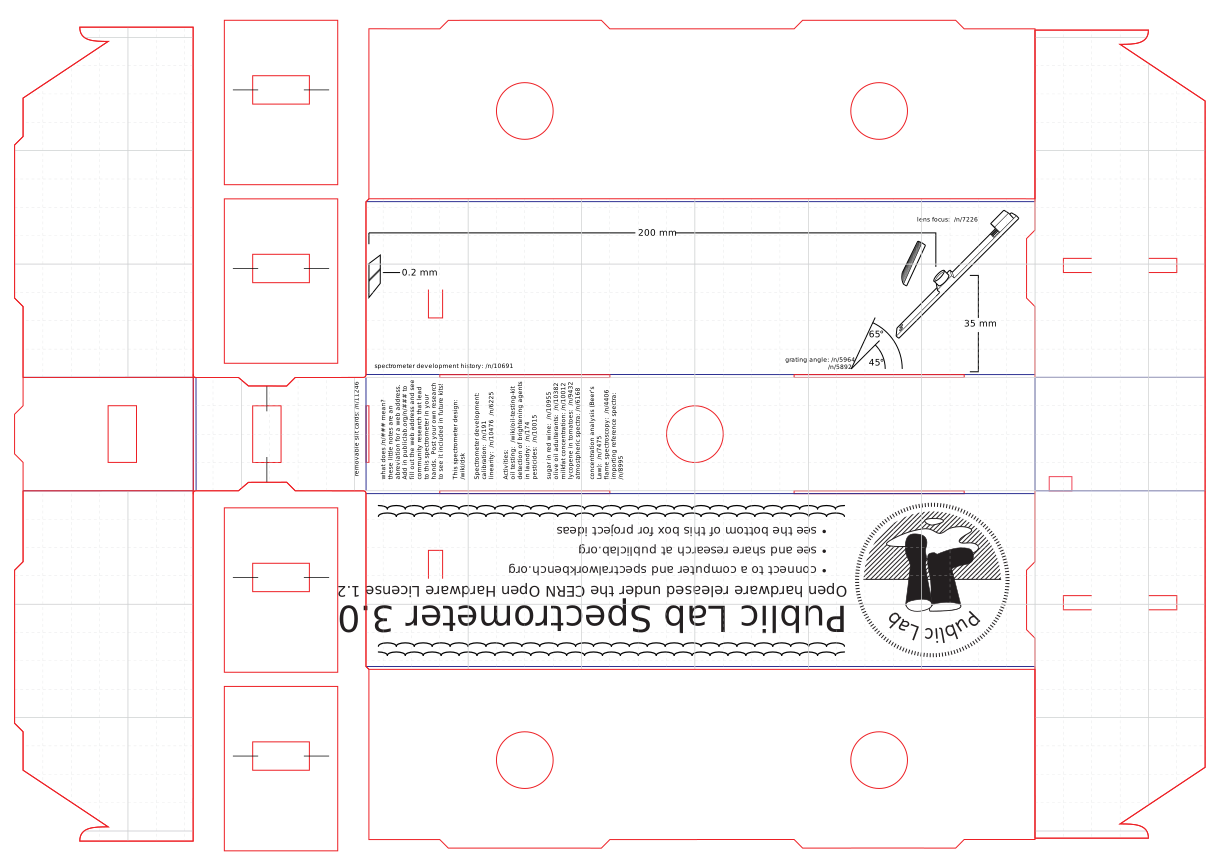
| Spectrometer Enclosure Base (Bottom Chassis) | Cut sheet ~430.0 mm × 305.9 mm, matte black cardstock | readily available (cut file live) | — | not checked (cardstock/laser cutting not priced) | spec-box-bottom.svg — fetched successfully |
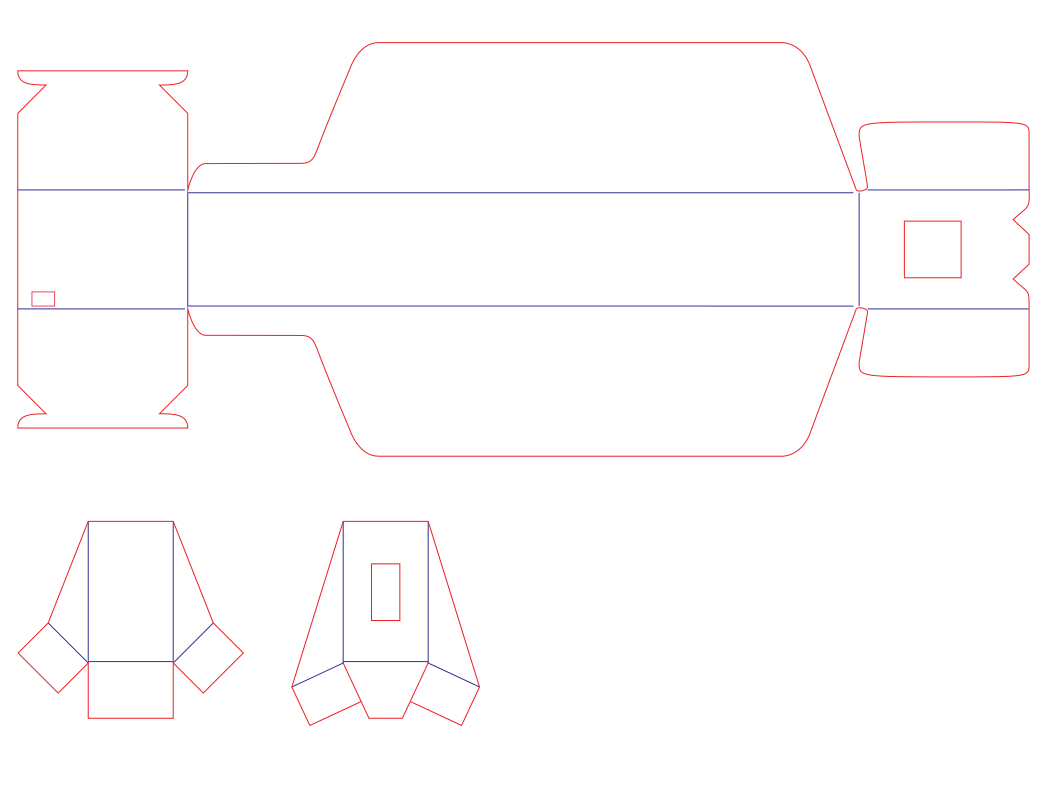
| Spectrometer Enclosure Lid and Angle Brackets | Cut sheet ~367.9 mm × 278.9 mm, 45° and 65° brackets | readily available (cut file live) | — | not checked (cardstock/laser cutting not priced) | spec-box-top+angles.svg — downloaded (pure vector, no text to extract) |
| Light-Blocking Assembly Tape | Opaque matte black tape, 12–25 mm wide | readily available | in stock, multiple sellers | $9.79 – $21.52 | Walmart seller (blackout tape); Filmtools (Shurtape P743 matte black); $12.00 CP-743, 1/2" at M. Cramer & Associates |
| USB Interface Cable — Tensility 10-00648 | Shielded USB 2.0 cable assembly, ≥ 1 m | readily available (Active) | 123 | $3.51 | DigiKey (Tensility International Corp) |
Notes on two rows above. The webcam: the fetched ELP-USB100W03M product page confirms UVC ("Free Drive Protocol: USB Video Class(UVC)"), DC5V USB bus power at 100–120 mA — comfortably inside the ≤ 500 mA budget — an OV9712 visible-light CMOS sensor, a 38 × 38 mm board (32 × 32 mm compatible) and a standard 1 m cable. It does not state manual focus. The one fetched page that does state manual focus (the ELP CS 2.8–12mm model, $46.20) carries it in the product title only; its spec table did not extract, so its board size and UVC status are not evidence. The grating: the 1,000 lines/mm figure comes from the seller's listing title — the fetched Bartovation page confirms the construction ("highly efficient embossed Holographic Optical Elements ... used for the direct viewing and analysis of spectra") but its variant table did not extract.
The USB cable is often not a separate purchase at all: the snapshot notes the cable is typically captive on the webcam module, and the fetched ELP page lists a 1 m cable as included.
Substitutes
None needed. No part in this bill of materials is obsolete, out of stock, unobtainable, or overpriced, so no substitute was proposed or verified. The alternatives the lab itself documents — a peeled DVD-R data layer in place of a purchased grating, 3D-printed 45°/65° brackets in place of the cardstock ones, any opaque substrate for the slit card — are design latitude the snapshot already grants, not substitutions this check needed to make.
Verify any substitute against its datasheet before ordering.
Other dependencies
- Enclosure cut files on GitHub — LIVE.
spec-box-bottom.svgfetched successfully from github.com/publiclab/spectrometer3;spec-box-top+angles.svgdownloaded as well (pure vector art, so no text came back — the download itself is what confirms it is still served). The repository page also responded, returning its description "Public Lab's open source Desktop Spectrometry Kit"; its file listing is JavaScript-rendered and did not extract, so the two files were confirmed individually instead. - publiclab.org research notes and wiki pages — NOT CHECKED. The lab depends on a large body of documentation there: lens focusing (/n/7226), grating angle (/n/5964, /n/5892), the removable slit card (/n/11246), calibration (/n/191), linearity (/n/10476, /n/6225), the hardware wikis (/wiki/dsk, /wiki/spectrometer) and the application notes (/n/174, /n/10015, /n/10955, /n/10382, /n/10012, /n/9432, /n/6168, /n/7475, /n/4406, /n/8995). Two representative URLs were fetched and both came back "Page could not be downloaded (blocked, timeout, or gone)"; the rest were not individually attempted. Check them in a browser before the term starts and keep local copies of anything students need.
- Fabrication — base sheet 430.0 mm × 305.9 mm and lid sheet 367.9 mm × 278.9 mm, cut and fold layers on separate vector layers, matte black interior finish, 80–100 lb cardstock or thin e-flute board. Taken from the snapshot; nothing external to check.
- Laser cutter or craft cutting plotter access, and the cardstock itself — not checked. No pricing was gathered for the raw substrate or for a cutting service.
Watch list
- publiclab.org documentation — the biggest risk to this lab by the next check. The parts are commodities; the irreplaceable asset is the community's calibration, alignment and application notes. Nothing in this run could confirm they are reachable. If that site goes away, the hardware is still buildable but the pedagogy around it is not.
- The webcam — a generic COTS line item with no stable part number. Specific models churn constantly, and "manual focus" quietly disappears from listings as vendors move to fixed-focus and autofocus modules. Expect to re-select a model, not re-order one.
- The GitHub cut files — live today, but the repository is the single point of failure for the enclosure. Mirror
spec-box-bottom.svgandspec-box-top+angles.svglocally now. - The Spectral Workbench software stack — see the Cybersecurity section above; it is the part of this lab that has actually drifted, and it will keep drifting.
Snapshot What the lab depended on when it was uploaded — the baseline the readiness checks research against.
The Public Lab Desktop Spectrometer 3.0 is an open-source optical spectrometer kit released under the CERN Open Hardware License 1.2. The system builds an optical bench enclosure from folded cardstock to capture, calibrate, and analyze visible light emission and absorption spectra. The design features a precision 0.2 mm entrance slit aperture, internal light baffling, a 200 mm optical bench path length, a 35 mm focal centerline height, and an internal mounting bracket that holds a transmission diffraction grating and a focus-adjustable camera at an angle of 45° or 65°. The physical apparatus contains no custom printed circuit boards; all electronic hardware consists of an off-the-shelf USB webcam module powered directly from a host computer via a standard 5 V DC USB bus rail (nominally 5 V, ≤ 500 mA). Captured spectra are digitized by the camera and transmitted over USB to a host PC running the Spectral Workbench web platform (either locally or via spectralworkbench.org).
Bill of Materials
Focus-Adjustable USB Webcam Module
- Identity: Commercial off-the-shelf UVC-compliant USB webcam or bare camera module with manual focus adjustment (historically generic Syba or Vimicro-based CMOS webcam modules).
- Quantity: 1
- Footprint/package: Compact chassis-mount or bracket-mount camera module fitting within a 35 mm optical center enclosure compartment.
- Electrical constraints: 5 V DC supply voltage powered via USB 2.0 bus (current draw ≤ 500 mA).
- Mechanical/optical constraints: Lens assembly must have a manual focus ring capable of focusing closely at a 200 mm object distance. Must possess a visible-light CMOS/CCD image sensor (wavelength response approximately 400 nm to 700 nm); any factory IR-blocking filter must permit visible light transmission.
- Substitution latitude: Any standard USB Video Class (UVC) webcam module can substitute, provided the outer housing fits inside the cardstock compartment or can be removed, and the lens can be manually refocused down to 200 mm.
- Operated control: Yes. The manual focus ring on the lens is an operated control adjusted by the user during initial setup and calibration to sharpen spectral line images (referenced as lens focus: /n/7226).
- Sourcing plan: retail shopping search: manual focus USB webcam module UVC 720p
Transmission Diffraction Grating
- Identity: Linear transmission diffraction grating; either a commercial holographic diffraction grating film sheet or a peeled recording layer from a blank DVD-R disc (approx. 1350 grooves/mm).
- Quantity: 1 piece (approximately 20 mm × 20 mm square).
- Footprint/package: Thin-film optical square mounted directly over the webcam lens aperture.
- Optical constraints: Linear transmission diffraction grating with groove density between 800 lines/mm and 1350 lines/mm. Mounted at an orientation angle of 45° or 65° to diffract the 1st-order spectrum across the camera image sensor.
- Substitution latitude: A standard 1000 lines/mm linear holographic diffraction grating sheet or a clean, separated DVD-R polycarbonate data layer can be substituted (as documented in Public Lab research notes /n/5964 and /n/5892).
- Operated control: No. Set-once alignment held fixed by internal angle brackets.
- Sourcing plan: retail shopping search: 1000 lines/mm transmission diffraction grating film sheet
Precision Slit Card (0.2 mm Aperture)
- Identity: Public Lab 0.2 mm removable slit card (documented in community research /n/11246 and cut plans).
- Quantity: 1 (cut plans include templates for 4 interchangeable slit cards).
- Footprint/package: Cardstock card insert (approx. 35 mm × 35 mm square) with a 0.2 mm wide centered slit aperture.
- Optical constraints: Slit width strictly 0.2 mm. Material must be completely opaque to ambient light to prevent light leakage around the aperture.
- Substitution latitude: Any rigid opaque substrate (heavy black cardstock, laser-cut plastic, or razor blade edges) providing an optical slit width of 0.2 mm can substitute. Slit width determines the tradeoff between light throughput and spectral line resolution.
- Operated control: Yes. Removable and swappable during operation to exchange apertures or sample holders.
- Sourcing plan: general web research: Public Lab 0.2 mm spectrometer slit card cut template
Spectrometer Enclosure Base (Bottom Chassis)
- Identity: Public Lab Spectrometer 3.0 Bottom Enclosure Cut Sheet (vector drawing: spec-box-bottom.pdf).
- Quantity: 1 sheet.
- Footprint/package: Die-cut or laser-cut cardstock / corrugated paperboard sheet (~430.0 mm × 305.9 mm flat size). Folds into a rectangular optical bench bench box with a 200 mm path length and 35 mm height.
- Mechanical/optical constraints: Interior surfaces must be non-reflective matte black to prevent internal optical reflections and light contamination. Features an entry slit holder and light baffle slots.
- Substitution latitude: Can be fabricated from 80 lb to 100 lb matte black cardstock, chipboard, or thin cardboard using a laser cutter or craft cutting plotter following the vector plans.
- Operated control: No.
- Sourcing plan: general web research: Public Lab Spectrometer 3.0 spec-box-bottom cut file
Spectrometer Enclosure Lid and Angle Brackets
- Identity: Public Lab Spectrometer 3.0 Top and Angle Brackets Cut Sheet (vector drawing: spec-box-top+angles.pdf).
- Quantity: 1 sheet.
- Footprint/package: Die-cut or laser-cut cardstock sheet (~367.9 mm × 278.9 mm flat size). Folds into the light-tight enclosure lid and two angled internal mounting brackets (45° and 65°).
- Mechanical/optical constraints: Must rigidly position the webcam and grating at a 45° or 65° angle relative to the 200 mm optical axis. Interior must be matte black.
- Substitution latitude: Can be cut from cardstock or substituted by 3D-printed 45° and 65° camera/grating mount brackets.
- Operated control: No.
- Sourcing plan: general web research: Public Lab Spectrometer 3.0 spec-box-top+angles cut file
Light-Blocking Assembly Tape
- Identity: Opaque matte black adhesive tape (photographic paper tape, black gaffer tape, or electrical tape).
- Quantity: 1 roll (used as needed for assembly).
- Footprint/package: Roll tape, width 12 mm to 25 mm.
- Optical constraints: 100% light-blocking opacity to seal paper enclosure joints, corners, and seam folds against ambient light contamination.
- Substitution latitude: Any completely opaque black tape or opaque craft adhesive.
- Operated control: No.
- Sourcing plan: retail shopping search: black light blocking photographic paper tape
USB Interface Cable
- Identity: USB 2.0 Type-A male to camera interface cable (typically captive/integrated on the webcam module, or standard USB-A to mini/micro-B).
- Quantity: 1.
- Footprint/package: Standard shielded USB cable assembly (length ≥ 1 m).
- Electrical constraints: 4-conductor shielded cable carrying 5 V DC power (VBUS, GND) and USB 2.0 differential data (D+, D-).
- Substitution latitude: Any standard USB 2.0 data cable compatible with the chosen webcam.
- Operated control: No.
- Sourcing plan: distributor lookup (representative example — sources give spec only): Tensility 10-00648
Software and network dependencies
Host Operating System / Environment:
- Platform: Debian / Ubuntu Linux (Ubuntu 18.04 LTS or compatible environment recommended in documentation; macOS via Homebrew and Fedora/CentOS also documented).
- Version: Stated in documentation (Ubuntu/Debian recommended).
- Version pinning: Unpinned.
- Check plan: support-status lookup: Ubuntu 18.04 LTS
Ruby Language Runtime:
- Name: Ruby
- Version: 2.6.6 (specified as "Ruby 2.6.6 up to Ruby 2.6.x").
- Where version came from: Stated in documentation (spectral-workbench_README.md).
- Version pinning: Stated in documentation as 2.6.6.
- Check plan: support-status lookup: Ruby 2.6.6
Bundler:
- Name: Bundler (Ruby gem dependency manager)
- Version: 1.17.2
- Where version came from: Pinned in Gemfile.lock (line 274: "BUNDLED WITH 1.17.2").
- Check plan: vulnerability lookup: bundler / rubygems / 1.17.2
System Image Processing Libraries:
- Name: ImageMagick and development headers (imagemagick, ruby-rmagick, libmagickwand-dev, libmagick++-dev on Debian/Ubuntu; ImageMagick-devel on Fedora).
- Version: Not stated (system package manager install: apt-get install imagemagick ruby-rmagick libmagickwand-dev libmagick++-dev).
- Where version came from: Stated in documentation without version constraint.
- Version pinning: Unpinned in spectral-workbench_README.md.
- Check plan: not checkable: system library packages unpinned
Node.js, NPM, and Yarn:
- Name: Node.js (nodejs-legacy, npm) and Yarn static asset manager (npm install -g yarn).
- Version: Not stated.
- Where version came from: Stated in documentation (spectral-workbench_README.md).
- Version pinning: Unpinned.
- Check plan: not checkable: npm and yarn installations unpinned
Database Engine:
- Name: MySQL Server (mysql-server) or SQLite3.
- Version: Not stated.
- Where version came from: Stated in documentation (spectral-workbench_README.md).
- Version pinning: Unpinned.
- Check plan: not checkable: database server version unpinned
Spectral Workbench Core JavaScript Module:
- Name: spectral-workbench.js (https://github.com/publiclab/spectral-workbench.js)
- Version: Not stated (cloned/included submodule).
- Where version came from: Stated in documentation (spectral-workbench_README.md).
- Version pinning: Unpinned.
- Check plan: not checkable: external JavaScript repository unpinned
Web Application Framework and Server:
- Ruby on Rails: version 5.2.4.6, pinned in Gemfile.lock (Gemfile declares ~> 5.2.4.3). Check plan: vulnerability lookup: rails / rubygems / 5.2.4.6
- Phusion Passenger: version 6.0.14, pinned in Gemfile.lock. Check plan: vulnerability lookup: passenger / rubygems / 6.0.14
- Puma: version 5.6.4, pinned in Gemfile.lock. Check plan: vulnerability lookup: puma / rubygems / 5.6.4
Core Application Ruby Gems (manifest located at Gemfile and Gemfile.lock): All 102 resolved gem dependencies are pinned in Gemfile.lock. Key direct operational and security-sensitive gems include:
- rmagick: version 4.2.6, pinned in Gemfile.lock. Check plan: vulnerability lookup: rmagick / rubygems / 4.2.6
- nokogiri: version 1.13.8, pinned in Gemfile.lock. Check plan: vulnerability lookup: nokogiri / rubygems / 1.13.8
- paperclip: version 6.1.0, pinned in Gemfile.lock. Check plan: vulnerability lookup: paperclip / rubygems / 6.1.0
- mysql2: version 0.5.4, pinned in Gemfile.lock. Check plan: vulnerability lookup: mysql2 / rubygems / 0.5.4
- rack: version 2.2.4, pinned in Gemfile.lock. Check plan: vulnerability lookup: rack / rubygems / 2.2.4
- therubyracer: version 0.12.3, pinned in Gemfile.lock. Check plan: vulnerability lookup: therubyracer / rubygems / 0.12.3
- uglifier: version 4.2.0, pinned in Gemfile.lock. Check plan: vulnerability lookup: uglifier / rubygems / 4.2.0
- recaptcha: version 5.9.0, pinned in Gemfile.lock. Check plan: vulnerability lookup: recaptcha / rubygems / 5.9.0
- open_id_authentication: version 1.3.0, pinned in Gemfile.lock. Check plan: vulnerability lookup: open_id_authentication / rubygems / 1.3.0
- ruby-openid: version 2.9.2, pinned in Gemfile.lock. Check plan: vulnerability lookup: ruby-openid / rubygems / 2.9.2
- bootsnap: version 1.12.0, pinned in Gemfile.lock. Check plan: vulnerability lookup: bootsnap / rubygems / 1.12.0
- sprockets: version 4.1.1, pinned in Gemfile.lock. Check plan: vulnerability lookup: sprockets / rubygems / 4.1.1
Network exposure:
- Physical device: The spectrometer hardware itself connects solely as a standard USB video device to a host workstation and carries no autonomous network interfaces.
- Local Web Server: The host application (Spectral Workbench) launches an HTTP server listening on TCP port 3000 (http://localhost:3000) via Passenger or Puma. Test suite runs a Jasmine client-side test server on port 8888 (http://localhost:8888).
- External Authentication / Network Connections: The application delegates user authentication via OpenID to publiclab.org; logging in redirects students to approve authentication against PublicLab.org credentials.
- Public Cloud API: Documentation instructs users that spectra can be published and analyzed remotely by submitting JSON payloads authenticated with an API token to the public cloud service at https://spectralworkbench.org/spectrums.json.
Online Resources and URL Dependencies
Public Lab Community Research and Calibration Documentation:
- Lens focusing guide: publiclab.org/n/7226
- Grating angle research: publiclab.org/n/5964 and publiclab.org/n/5892
- Removable slit card design: publiclab.org/n/11246
- Spectrometer development history: publiclab.org/n/10691
- Calibration procedures: publiclab.org/n/191
- Linearity studies: publiclab.org/n/10476 and publiclab.org/n/6225
- General hardware wiki: publiclab.org/wiki/dsk and publiclab.org/wiki/spectrometer
- Application use-case notes: /wiki/oil-testing-kit, /n/174 (brightening agents), /n/10015 (pesticides), /n/10955 (wine sugar), /n/10382 (olive oil), /n/10012 (milkfat), /n/9432 (lycopene), /n/6168 (atmospheric spectra), /n/7475 (Beer's Law), /n/4406 (flame spectroscopy), and /n/8995 (reference spectra).
Source Code Repositories:
- Web application repository: https://github.com/publiclab/spectral-workbench.git
- Core spectral JS library: https://github.com/publiclab/spectral-workbench.js
Fabrication Specifications
Enclosure Base Sheet (spec-box-bottom.pdf):
- Total sheet boundary / MediaBox: 1219 pt × 867 pt (approx. 430.0 mm × 305.9 mm / 16.93 in × 12.04 in).
- Layer content: Single-page Adobe Illustrator CS6 cut plan containing perimeter cutting vectors (red lines), interior fold score lines (blue lines), and assembly/reference alignment markings.
- Substrate: Opaque heavy cardstock (80 lb to 100 lb) or thin corrugated e-flute board with matte black light-absorbing interior finish.
Enclosure Lid and Brackets Sheet (spec-box-top+angles.pdf):
- Total sheet boundary / MediaBox: 1043 pt × 790.5 pt (approx. 367.9 mm × 278.9 mm / 14.49 in × 10.98 in).
- Layer structure: Two distinct layers / optional content groups:
- Layer 1 (OCG /MC0): Die-cut / laser cut vector paths and fold score lines for box lid and 45°/65° mounting angle brackets.
- printing (OCG /MC1): Silk-screen / print graphics and alignment markings.
- Substrate: Identical cardstock or corrugated board matching the base enclosure.